How to Determine the Urine Anion Gap
What Is the Urine Anion Gap?
The urine anion gap is a practical way to gauge how much ammonium excretion is happening in the kidneys using routine electrolytes from a urine sample. It is often used in the assessment of acid-base balance because it helps clinicians determine whether the kidneys are responding appropriately to metabolic acidosis.
In simple terms, the urine anion gap is a replacement marker for renal acid excretion. When the body is acidotic, healthy kidneys increase ammonium production and excretion to clear acid. Because ammonium is not always directly measured in standard labs, the urine anion gap gives a useful estimate based on measured ions.
This makes it a valuable diagnostic tool in clinical assessment, especially when distinguishing causes of non-anion gap metabolic acidosis. The result can aid the broader clinical differential diagnosis by suggesting whether the problem is renal or extra-renal.
The urine anion gap is not the same as the serum anion gap, which is used for blood acid-base analysis. Instead, this calculation uses urinary sodium concentration, potassium concentration, and chloride concentration to infer renal handling of acid and electrolyte balance.
Urinary Formula for Anion Gap and Determination
The central computational formula for the urine anion gap is straightforward:
Urine Anion Gap = Urine sodium + Urine potassium − Urine Chloride
Using the standard notation:
- Urine sodium = Na+
- Urine potassium = K+
- Urine chloride = Cl−
The idea is that the measured cations in the urine are evaluated alongside the main measured anion. If chloride is lower than expected compared with sodium and potassium, the gap becomes positive. If chloride is relatively high, the gap becomes less than zero.
This calculation is often performed with an anion gap calculator, particularly when reviewing urine electrolytes quickly. Whether done manually or with a calculator, the process is the same: provide the urine sodium, urine potassium, and urine chloride values from the laboratory result.
Example values for the formula:
- Urine sodium = 40 mEq/L
- Urine potassium = 20 mEq/L
- Urine chloride = 70 mEq/L
Calculation:
40 + 20 − 70 = −10 mEq/L
That below-zero result has an important interpretation, which is covered in the next section.
How to Understand a Positive, Negative, or Neutral Result
The interpretation is the key reason the urine anion gap matters. The number itself is not as important than what it suggests about ammonium handling and the underlying cause of acid-base imbalance.
A low urine anion gap generally suggests that ammonium excretion is higher. Since ammonium is excreted with chloride, more urinary chloride tends to push the calculated gap downward. This pattern is often seen when the kidneys are properly responding to acid load, such as in gastrointestinal bicarbonate loss from diarrhea.
A elevated urine anion gap often suggests reduced ammonium excretion. This suggests toward a renal problem, especially renal tubular acidosis. In particular, distal renal tubular acidosis is a classic cause because the distal nephron cannot acidify urine properly, leading to impaired acid excretion.
A value near zero can be harder to interpret. It may reflect moderate ammonium excretion, mixed physiology, or simply limited precision in the urine electrolytes. In practice, a zero or near-zero result should be interpreted in the full clinical context rather than in isolation.
Here is a simple interpretation guide:
- Low urine anion gap: suggests increased ammonium excretion and a non-renal cause of acidosis, such as gastrointestinal bicarbonate loss.
- Elevated urine anion gap: points to decreased ammonium excretion and a renal cause, such as distal renal tubular acidosis.
- Zero: unclear; check other findings and repeat if needed.
Because the urine anion gap is an indirect marker, it should be used as an additional clue rather than a stand-alone answer. It can support suspicion for a specific diagnosis, but it does not substitute for the rest of the evaluation.
Step-by-Step Illustration with an Anion Gap Calculator
By using an anion gap calculator for urine measurements can speed up the procedure and limit math mistakes. Here is a straightforward example calculation from a urine sample.
Let’s say the laboratory lists these urine electrolytes:
- Urine sodium = 18 mEq/L
- Urine potassium = 12 mEq/L
- Urine chloride = 8 mEq/L
1.) Combine urine sodium and urine potassium.
18 + 12 = 30
2.) Deduct urine chloride.
30 − 8 = 22 mEq/L
Step 3: Evaluate the result.
A urine anion gap of +22 mEq/L is elevated, which indicates reduced ammonium excretion. In the setting of metabolic acidosis, this finding is consistent with a renal cause such as renal tubular acidosis, including distal renal tubular acidosis, rather than a gastrointestinal source of bicarbonate loss.
Consider now a second sample:
- Urine sodium = 35 mEq/L
- Urine potassium = 15 mEq/L
- Urine chloride = 65 mEq/L
35 + 15 − 65 = −15 mEq/L
This low result suggests greater ammonium excretion, which is more compatible with a non-renal cause of acidosis, such as gastrointestinal bicarbonate loss.
As you review the result, always relate the number to the patient’s acid-base status, kidney function, and urine pH. A calculator renders the arithmetic easy, but the clinical meaning still depends on assessment of the whole picture.
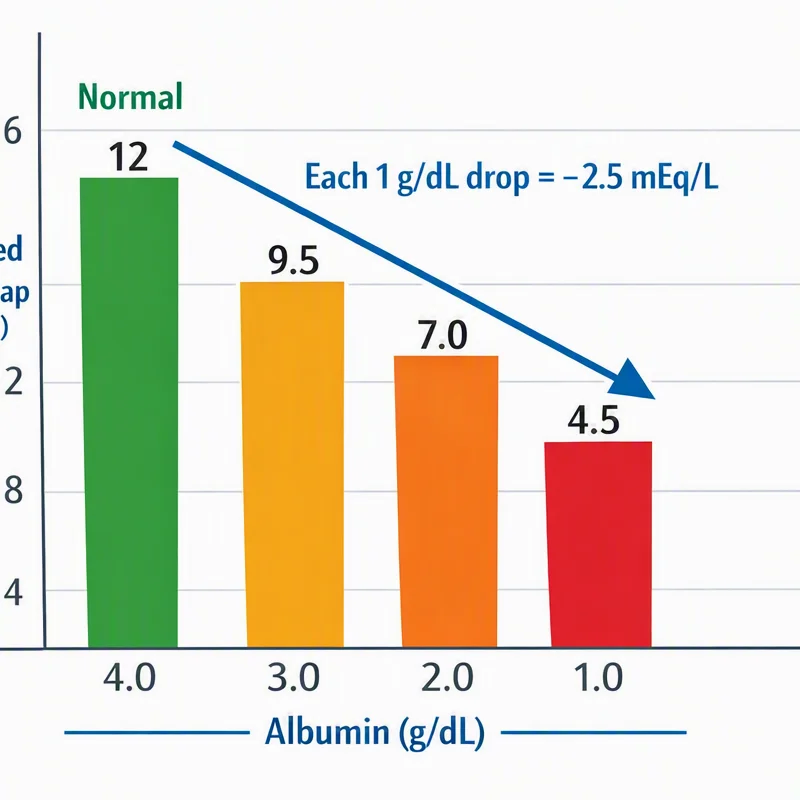
When the Urine Anion Gap Is Valuable
The urine anion gap is especially helpful in non-anion gap metabolic acidosis. In this context, the serum bicarbonate is low, but the usual serum anion gap is not elevated, so clinicians often need a way to tell apart renal from non-renal causes.
This is where the test becomes useful for assessing renal acid excretion and overall kidney function. If the kidneys are working properly, they should respond to acidosis by increasing ammonium excretion. If they are not, the urine anion gap may stay positive.
Common clinical situations where the urine anion gap may help include:
- Suspected renal tubular acidosis
- Evaluation of distal renal tubular acidosis
- Workup of unexplained metabolic acidosis
- Distinguishing renal causes from gastrointestinal bicarbonate loss
- Broader clinical differential diagnosis of acid-base disorders
In practice, the urine anion gap is most helpful when the diagnosis is not obvious from history alone. For example, a patient with diarrhea and acidosis may have a negative urine anion gap, supporting adequate renal acid handling. By contrast, a patient with persistent acidosis and a positive result may need further evaluation for renal tubular dysfunction.
This makes the test a useful bridge between lab data and bedside reasoning. It gives a quick window into renal handling of acid without requiring specialized ammonium measurement.
Constraints and Common Pitfalls
While helpful, the urine anion gap has notable limitations. A thorough reading of the urine pH, volume status, and overall clinical picture is crucial before drawing conclusions.
A key limitation is that the calculation assumes the main unmeasured cation is ammonium. That is commonly true, but not always. The presence of unmeasured anions can distort the result and make interpretation less reliable. For example, certain medications or unusual urinary solutes may affect the measured values.
Measurement error is another problem. Small differences in urine sodium, urine potassium, or urine chloride can change the final answer, especially when the result is close to zero. A borderline value should be interpreted prudently.
Volume status also matters. Concentrated urine, dilution, or recent fluid administration can shift urine electrolyte concentrations and affect the calculated gap. For that reason, a single result should not supersede the rest of the assessment.
Urine pH is often checked alongside the urine anion gap, but it is not a substitute for it. A urine pH that is not appropriately acidic may support the idea of distal tubular dysfunction, yet the urine anion gap may provide extra insight into ammonium excretion. The two tests answer related but different questions.
Frequent pitfalls include:
- Relying on the result without considering clinical context
- Ignoring the possibility of unmeasured anions
- Overinterpreting a borderline or zero result
- Assuming a positive result always proves renal disease
- Forgetting that laboratory interpretation depends on specimen quality
The best approach is to treat the urine anion gap as one piece of evidence. It is strongest when combined with the history, serum studies, urine pH, and the rest of the acid-base assessment.
Urine Anion Gap Versus Serum Anion Gap
It is common to confuse the urine anion gap with the serum anion gap, but they are used for separate purposes. The serum anion gap is measured from blood chemistry values and helps classify metabolic acidosis as anion-gap or non-anion-gap. The urine anion gap, on the other hand, is used to gauge ammonium excretion and evaluate renal response.
In plain language, the serum anion gap helps answer, “What type of metabolic acidosis is present?” The urine anion gap helps answer, “Is the kidney appropriately excreting acid?”
This distinction matters in laboratory values and laboratory interpretation. A patient may have a normal serum anion gap but still need a urine anion gap to clarify the cause of acidosis. Likewise, the urine anion gap is not intended to substitute for the serum anion gap when evaluating the overall acid-base picture.
Here is the practical comparison:
- Serum anion gap: evaluates blood chemistry and helps categorize metabolic acidosis.
- Urine anion gap: evaluates urinary electrolyte patterns and estimates ammonium excretion.
Both tests can be useful in the same patient, but they tackle different questions. In difficult cases, the best interpretation comes from combining both with the rest of the clinical assessment.
Frequently Asked Questions
How do you calculate the urine anion gap calculated?
Use the formula: urine sodium + urine potassium − urine chloride. This gives the urine anion gap. This calculation is usually done typical anion gap range with a urine sample and can be checked quickly with an anion gap calculator.
What does a low urine anion gap mean?
A low urine anion gap usually means ammonium excretion is increased. That suggests the kidneys are responding appropriately to acidosis and makes gastrointestinal bicarbonate loss a more likely cause than renal failure to excrete acid.
What does an elevated urine anion gap indicate?
A elevated urine anion gap generally suggests decreased ammonium excretion. In a patient with metabolic acidosis, this supports a renal cause such as renal tubular acidosis, including distal renal tubular acidosis.
What is the usual urine anion gap range?
The normal range is often considered around zero to slightly negative, but exact interpretation depends on the laboratory and the clinical setting. Because the value is indirect, the most important issue is whether it suggests increased or decreased ammonium excretion.
When should a urine anion gap be used clinically?
It is most useful in non-anion gap metabolic acidosis when you need help with clinical differential diagnosis. It can support decisions about whether the problem is related to the kidneys, kidney function, or extra-renal bicarbonate loss, and it is especially helpful when urine pH and other labs leave uncertainty.