Anion Gap Calculator for Urgent Care Medicine Application
Understanding the Anion Gap and Why It Is Important
The anion gap is a valuable laboratory-based value used to detect the cause of metabolic acidosis and other imbalances in electrolytes. In the emergency department, it serves as a rapid screening tool for https://anion-gap-reader007.quillnesty.com/posts/how-to-use-an-anion-gap-calculator-for-lab-tests acid-base balance problems and assists clinicians focus a broad differential into a targeted diagnostic algorithm.
An anion gap calculator is useful because the underlying concept is simple, but the interpretation is not. A patient may present with an apparently mild metabolic derangement, yet the pattern of serum electrolytes can reveal serious illness such as lactic acidosis, ketoacidosis, toxic ingestion, or renal failure. The gap represents the difference between measured cations and measured anions, which reflects unmeasured anions in the blood.
For emergency medicine, the anion gap is not just a number. It is a piece of clinical decision support that helps identify whether the patient likely has high anion gap metabolic acidosis, normal anion gap metabolic acidosis, or another acid-base disorder altogether. It also guides whether to obtain additional studies such as a venous blood gas, lactate, ketones, toxicology testing, or an osmolar gap.
How to Determine the Anion Gap
The standard anion gap formula uses the primary measured electrolytes: sodium, chloride, and bicarbonate. One common form is:
Anion gap = Sodium − (Chloride + Bicarbonate)
Potassium is sometimes included in laboratories and references, but in emergency practice, the sodium-based formula is used most often because it is simple, rapid, and widely available on the basic metabolic panel. The result reflects the amount of anion deficit from unmeasured ions.
Example: if sodium is 140, chloride is 104, and bicarbonate is 20, the calculation is 140 − (104 + 20) = 16. That value may be normal or somewhat increased depending on the lab reference range and the patient’s clinical context.
An anion gap calculator simplifies this diagnostic calculation, limiting manual errors during time-sensitive critical care evaluation. It also helps clinicians quickly compare sequential results from an electrolyte panel when monitoring a patient’s response to treatment.
Using the Anion Gap Calculator in acute care
In acute care, the calculator is particularly valuable when a patient has unexplained and persistent tachypnea, altered mental status, hypotension, vomiting, dehydration, or concern for toxicity. It is typically used alongside the BMP, point-of-care testing, and at times blood gas analysis.
Point-of-care testing can provide quick sodium, chloride, and bicarbonate values that allow clinicians to identify metabolic abnormalities early. This matters when the patient may be deteriorating and decisions about fluids, insulin, bicarbonate, antidotes, or dialysis need to be made promptly.
Practical use in the emergency department often follows this sequence:
- Assess the electrolyte panel and calculate the anion gap.
- Verify whether the patient has an acid-base disturbance on a venous blood gas or arterial sample.
- Consider whether the pattern suggests elevated anion gap acidosis or hyperchloremic metabolic acidosis.
- Order confirmatory tests such as lactate, beta-hydroxybutyrate, ketones, renal function, or toxicology studies.
The value of the calculator is not in isolation, but in the way it strengthens result interpretation and supports early recognition of dangerous disease. In a busy ED workflow, it is one of the most efficient ways to screen for major acid-base pathology.
Normal, Increased, and Reduced Anion Gap Values
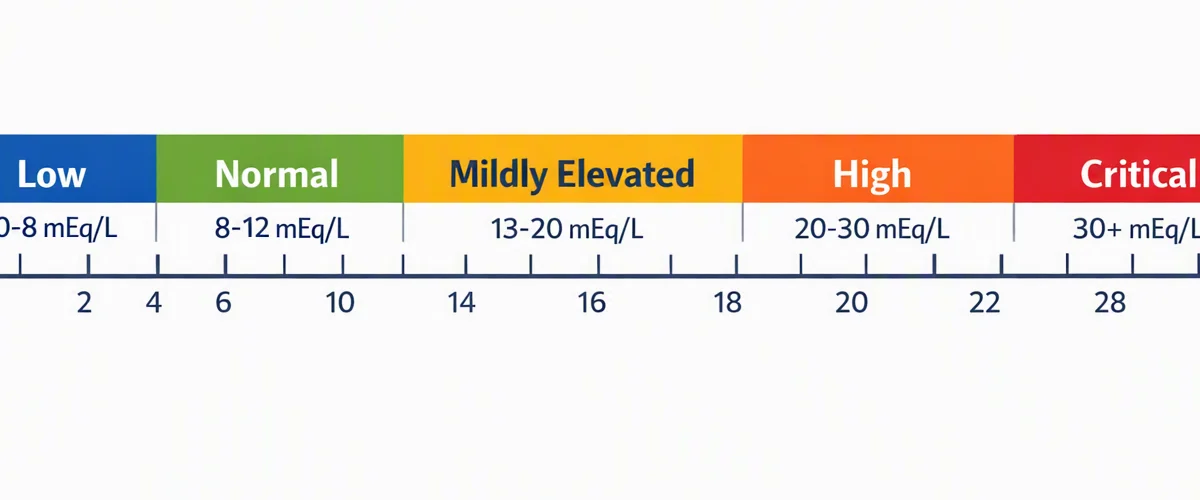
A normal anion gap usually implies that any acidosis present is caused by bicarbonate loss or chloride buildup rather than by accumulation of unmeasured acids. However, “normal” depends on the laboratory method and reference range, so clinicians should always read the value using site standards.
High anion gap metabolic acidosis points toward too much unmeasured acids in the circulation. This is the result that often prompts urgent evaluation for lactic acidosis, ketoacidosis, toxic alcohols, and renal failure. It is a key signal in medical evaluation when a patient appears sick or has concerning vital signs.
A low anion gap is less common and can be overlooked. It may occur with severe low albumin, laboratory artifact, or occasionally other less common clinical conditions. Although a low value is not usually the main immediate problem, it should prompt review of the test result and the broader acid-base disorder.
For practical interpretation, the anion gap should be seen as a pattern based tool rather than a single diagnosis. The presence of a normal or abnormal gap helps shape the next step in the diagnostic pathway, not replace it.
Frequent Causes of a Elevated Anion Gap
Various conditions can result in high anion gap metabolic acidosis, and the emergency clinician should think in terms of rapid identification of critical causes. The most common and important include lactic acidosis, ketoacidosis, and exposure to toxic alcohols.
Lactic acidosis often develops in shock, hypoperfusion, seizures, severe infection, or tissue ischemia. In the ED, this is a top concern in patients with possible sepsis, hypotension, or respiratory compromise. The anion gap may climb as lactate accumulates and uses up bicarbonate during buffering.
Ketoacidosis occurs when ketone bodies accumulate as organic acids. Diabetic ketoacidosis is the typical emergency presentation, but starvation or alcoholic ketosis can also be involved. The bicarbonate level often falls markedly, and the anion gap rises because ketones are unmeasured anions.
Toxic alcohols are another critical cause of a high gap. Ethylene glycol and methanol are especially important because they can result in serious organ injury and may initially present with nonspecific symptoms. In these cases, the anion gap may increase later in the course, so timing matters. An elevated gap with suspicion of ingestion should prompt consideration of an osmolar gap and immediate toxicity screening.
Additional causes may exist, but these three are the top priorities in the ED because they are time-sensitive and potentially reversible with prompt treatment.
Typical Causes of a Normal Anion Gap Acidosis
Normal anion gap acidosis is often linked to bicarbonate loss or limited acid excretion. A typical lab pattern includes a fall in bicarbonate with a compensatory rise in chloride, creating hyperchloremic acidosis.
Diarrhea is a frequent cause. Gastrointestinal bicarbonate loss can decrease bicarbonate levels while chloride goes up to preserve electrical neutrality. This is a straightforward example of how the chloride shift helps maintain balance on laboratory reports while the patient stays metabolically acidotic.
RTA is another key cause. With this disorder, the kidneys cannot adequately acidify the urine or reabsorb bicarbonate, leading to persistent acidosis despite a normal anion gap. Identifying it matters because it may suggest chronic or underlying kidney dysfunction rather than a brief illness.
Normal anion gap acidosis can also occur after substantial saline infusion, though the main urgent causes to keep in mind remain diarrhoea, RTA, and kidney bicarbonate loss. A careful review of fluids, medications, and recent illness helps distinguish these patterns.
How the protein albumin Alter the Anion Gap
the protein albumin serves as the key unmeasured anion in plasma, so a low albumin level can falsely lower the anion gap. That matters because a patient may have a important acidosis that appears milder on the initial calculation.
This is why clinicians often use a anion gap correction when hypoalbuminemia is present. One common method is to adjust the measured gap upward when albumin is below normal, allowing detection of hidden excess acids. The exact correction method may vary by institution, but the principle is the same: low albumin can hide a dangerous elevation.
This calculation is especially relevant in critical care and in patients with hepatic disease, malnutrition, inflammation, or chronic illness, where low albumin is often seen. Without correction, the anion gap may underestimate the true degree of metabolic derangement.
In practice, a corrected calculation strengthens lab interpretation and can detect a masked high gap when the raw result appears misleadingly normal. This is one reason the anion gap calculator is most useful when used together with albumin data rather than used alone.
Step-by-Step Assessment in the ED
Reading the anion gap in the emergency department should follow a systematic approach. The goal is to identify the underlying acid-base disorder promptly and decide whether immediate treatment is needed.
Step 1 — Verify the chemistry values. Inspect sodium, chloride, and bicarbonate from the basic metabolic panel or point-of-care source. Make sure the result is credible and not obviously affected by laboratory error.
Step 2: Assess whether the patient has metabolic acidosis on a venous blood gas or other blood gas measurement. A low bicarbonate alone is not enough; pH and respiratory compensation help clarify the full picture.
Then: Classify the gap as normal, elevated, or low. If elevated, prioritize lactic acidosis, ketoacidosis, renal failure, and toxic alcohols. If normal, focus on bicarbonate loss or chloride excess.
Step 4: If the presentation suggests ingestion, check the osmolar gap. An elevated osmolar gap with metabolic acidosis heightens concern about toxic alcohol exposure, especially when clinical findings are unclear.
Step 5: Combine all findings with the story. The same lab result means something different in a stable patient with mild diarrhea than in a hypotensive patient with altered mentation and respiratory distress.
This organized method is essentially a bedside diagnostic algorithm that pairs the calculator with patient status, blood gas data, and additional labs. It is a practical example of metabolic evaluation in real-time care.
Limitations and Problems of the Calculator
Like any diagnostic calculation, the anion gap calculator has limitations. Small differences in lab methods can create measurement variation, so the exact normal range can change between institutions and analyzers.
Laboratory error can also mislead interpretation. Hemolysis, specimen handling issues, or inconsistent repeat values may produce a result that does not fit the clinical picture. When the number and the patient do not match, repeat testing and correlation with other data are essential.
The calculator cannot replace the clinical context. Even a modest elevation can be significant in a toxic, unstable patient, while a higher result may be long-standing or somewhat compensated in a patient with known kidney disease. The anion gap should be read as part of the overall clinical picture rather than as a single trigger.
Other pitfalls include failing to account for albumin, treating every elevated gap as a single-cause problem, or missing a mixed acid-base disorder. The most accurate interpretation usually comes from pairing the anion gap with blood gas findings, renal function, ketones, lactate, and toxin screening when indicated.
When to Escalate Evaluation or Treatment
Escalate without delay when the anion gap suggests a serious condition such as sepsis, renal failure, or poisoning. These are not just lab abnormalities; they are time-sensitive emergencies that can worsen quickly without treatment.
In suspected sepsis, an elevated gap plus elevated lactate or hemodynamic instability should trigger rapid resuscitation, cultures, antimicrobial therapy, and source evaluation. In renal failure, worsening acidosis may require nephrology input, close electrolyte monitoring, and possible renal replacement therapy depending on the overall picture.
For suspected poisoning, especially with toxic alcohols, ethylene glycol, or methanol, do not delay for confirmatory results if the clinical suspicion is high. The combination of acidosis, elevated gap, and possible osmolar gap can justify urgent antidotal therapy and consultation with toxicology.
It is also appropriate to escalate when the patient has worsening mental status, respiratory fatigue, shock, or rapidly changing laboratory values. The calculator should direct the next step, not delay it.
Frequently Asked Questions
What is the anion gap calculator used for?
The anion gap calculator is used to rapidly estimate the anion gap from serum sodium, chloride, and bicarbonate values. In emergency medicine, it helps clinicians identify metabolic acidosis, differentiate acid-base disorders, and decide whether further evaluation for lactic acidosis, ketoacidosis, toxic alcohols, or renal failure is needed.
What’s the normal range for the anion gap?
The usual range depends on the measurement method and reference standard used by that facility. Because assay methods vary, clinicians should interpret the value using the facility’s range rather than relying on a single cutoff. In practice, the result is best anion gap clinical significance understood in along with the patient’s symptoms, bicarbonate level, and overall acid base status.
How is a corrected anion gap for albumin?
To estimate a corrected anion gap, clinicians modify the measured result upward when albumin is low because hypoalbuminemia can hide a true elevation. The exact correction formula can vary, but the goal is the same: account for the effect of low albumin on the gap so that significant metabolic acidosis is not missed. This is especially useful in patients with ongoing disease, liver disease, or critical illness.
What causes a high anion gap in emergency medicine?
The most important causes of high anion gap metabolic acidosis in emergency medicine include lactic acidosis, ketoacidosis, and toxic alcohols such as ethylene glycol and methanol. Other important causes include sepsis and renal failure. The anion gap should be interpreted with blood gas results, lactate, ketones, renal studies, and the patient’s overall status.
When should an osmolar gap be checked with anion gap results?
An osmolar gap should be checked when there is concern for ingestion, especially if the patient has unexplained acidosis, altered mental status, or a history that suggests possible exposure to toxic alcohols. It is particularly useful when evaluating possible ethylene glycol or methanol poisoning. In the ED, the osmolar gap adds another layer of toxicity screening to the broader metabolic evaluation.